Showing posts with label book review. Show all posts

Wednesday, August 20, 2014

Good People

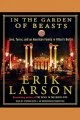
If you get a chance to read the book, In the Garden of Beasts : love, terror, and an American family in Hitler's Berlin, by Eric Larson, I hope you take the opportunity. It is the true story of the American Ambassador to Germany and his family in 1933 and 1934.  Very easy to read, this book is a true eye opener. 

How did this happen? you will ask many times as you read through. Why wasn't something done to stop this? I don't know the answers to these questions, but, for me, the story raised a lot of other questions. Are we living in a comparable time, where evil is breeding in different parts of the world? Do we have an obligation to combat this evil, to try and stop it?

I have always believed that we should never have sent troops to Viet Nam, Afghanistan, or anywhere in the Middle East. This is not a reflection on the men and women who were sent to fight; they are truly the heroes in all of this, doing their best to protect our country. I think the boys and girls in Washington are to blame for most of the wars we have been involved in. But it doesn't seem to matter who is in power in Washington, the wars drag on.

This book has given me serious pause. There were several times I said to myself that the rise of Hitler should never have happened. What happened to the good people of the world? Is our situation today analogous? What should we do about it? Should we bring all the troops home? My answer to this question for the last several years has been Yes. But now I wonder, if good people do nothing, who will? If good people do nothing, are they good people?

It reminds me of the poem attributed to Martin Niemõller:
              
First they came for the Socialists, and I did not speak out—
Because I was not a Socialist.
Then they came for the Trade Unionists, and I did not speak out—
Because I was not a Trade Unionist.
Then they came for the Jews, and I did not speak out—
Because I was not a Jew.
Then they came for me—and there was no one left to speak for me.

Maybe you shouldn't read this book. It could raise serious questions for you, too.

Thursday, December 27, 2012

If Only.....What If

If only.... What if....

Have you ever had thoughts like these? What if I had gone to  college? Or moved to a different city? If only I had followed up on that one business opportunity, or joined that one group. What might my life have been like then? Would I have been happier? Wealthier? Healthier? I think all of us have a tendency to look back and wonder what might have been, if only I had done _________ (fill in the blank).

However, I like to think I have been fairly successful in looking to the future instead of the past. When it comes time to make a decision, any decision, I tell myself to make the best choice (or what I think is the best choice) at that moment in my life, and move on. Do not look back. This reasoning has kept me fairly sane throughout my life. (Please don't ask my sisters if I am reasonably sane; they could give you a different answer.)

Anyway, I think that this kind of logic is what makes it hard for me to read a book like
Destiny of the Republic: A Tale of Madness, Medicine, and the Murder of a President, by Candice Millard. Because this book is about a local man—Garfield's home was, and still is, in Mentor—I had to read it. is a very well-written and compelling book about the assassination of President James A. Garfield.  It intertwines the life and death of Garfield with inventions by Alexander Graham Bell and discoveries by the French scientist Joseph Lister.

Although the book was very good, I had a hard time reading it because it concentrated a lot on What If... and If Only, making me a bit depressed about what might have been. But if you like history and/ or biography, you will want to read this book. It gives us a picture of a man who would have made a great difference in this country, if only he had lived to serve out his term, or terms, as President.

Wednesday, May 23, 2012

Comments on a Recently read Book

I just finished reading The Post-American World | Release 2.0  by Fareed Zakaria (thanks for the recommendation, VBob). Written in understandable language, it is timely and eye-opening, as well as offering hope for the future of the United States.

The U.S. will be the world's only super power for a while yet, but other countries will continue to move up the ladder. We, as Americans, need to recognize that we live in a global society, and we only harm ourselves if we think we can pull back into an isolationist shell. We need to reach out to the rest of the world, not only with guns and aide, but with openness and understanding.

Most of the world's developing and developed countries are more or less closed societies, that are not replacing the population as it ages. The U.S. has always attracted people from other countries; we have a vibrant and growing (and young) work force.  This gives us a tremendous advantage over other countries. The U.S. has always welcomed people trying to better themselves, or looking for religious or political freedom, and we shouldn't close our doors now.

Besides, someone has to pay for my Social Security benefits.

Thursday, April 12, 2012

Good Music; Good Book

Whether or not this feeling I have right now will last, it is currently strong enough that I have to write something about it.

Den put a CD by Odetta on the stereo to test one of his tubes, or speakers, or something else I don't understand, but it is simply a wonderful CD, brought to our attention by a good friend, Laurie, who knows the kind of music I like. The title is One Grain of Sand, and was first recorded in1963.

Maybe it is because I am reading a book about race relations in the South in the late '60s and early '70s that  this music seems so powerful right now, or maybe not. The book is Blood Done Signed My Name, by Timothy Tyson, and is really good—reads like a novel, but is a true story written by the son of a white Methodist minister who served a white congregation in North Carolina. I am half-way through the book; it is a very powerful story about the murder of a young black man in Oxford, N.C., how race relations were changing, and how the changes came about. Having grown up in the North, I had no idea how oppressed African Americans had become, and still were, in the 20th century. It seems there was more equality right after the Civil War than there was when the Civil Rights Acts of 1964 and 1968 were passed.

Reading this book, and listening to this CD at this particular point in the reading (just past half-way), has made me wonder where I was when all this going on. Why wasn't I more aware? Why didn't I do something? Of course, I knew about the marches, the assassinations, the bombings; but they did not seem as real to me then as this story does now. I'm not sure anything will be changed by discovering something I didn't know 45 or 50 years ago, but maybe there is some value in hindsight.

Saturday, July 2, 2011

Another Book Review

Too many people out of work; the people who do have jobs have to work overtime to make ends meet. Meanwhile, the insurance companies, oil companies, and financial institutions are making record profits and paying their executives huge bonuses on top of prodigious salaries. Does all this sound familiar? It should; it's what's happening in our country today.

I just finished reading Invisible Hands; The Making of the Conservative Movement from the New Deal to Reagan by Kim Phillips-Fein. As the name of the book implies, the author follows the big companies, the big power brokers and the top company executives as they made, and continue to make, the decisions on how this country should be run.

These relatively few people have somehow convinced the rest of us, including the people who represent us in our government, that they know what is best for the U.S., and should be allowed to do as they please. I think our government representatives have fallen for this line of thinking because they have been dazzled by being chosen to have lunch with, or play golf with, or fly on private jets with, these very wealthy narcissists. These so-called captains of industry are the ideological descendants of the long-ago bosses who opposed doing away with the child labor laws, who opposed limiting the work week to 40 hours, who thought they had a right to pollute the air and water and earth because they could make a few extra dollars doing it. Today, they oppose health care for everyone (only those who can afford it should have it), social security as an entitlement (which it is not; we have all paid for it through our payroll deductions), and any type of a safety net for a person who has had his or her job pulled out from under him or her, among other things.

It is very hard for me to believe that we have been boondoggled by these high-flying thugs for so long, when they are only interested in what makes them money. Why not hire more people at decent wages so each one doesn't have to work 60 hours a week? Families would have more time to spend together. Isn't this what we want? Or do we just want to lament the demise of the American family? Why not support the unions who are fighting for decent wages for all workers? These are just a few of the questions we should be asking.

 Isn't it time we woke up? This is our country, and our world; shouldn't we take it back?  And by this, I don't mean getting rid of President Obama; he's doing better under the circumstances than expected. I do mean getting rid of, or at least taking a hard look at the senators and congressmen (all right—I mean mostly Republicans) who spout business theories handed to them by big business, and actually believe those things work, or at least pretend to believe. Our country—and our world—is too populous for us to revert back to the good ol' days of the early twentieth century. We need to think about conserving our natural resources so that future generations will be able to live at least as well as we have.  We need to consider legislation that would give support to all citizens, no matter their circumstances. We are, or at least were, a very wealthy country, and some of that wealth should be returned as services to the ordinary citizens, in the form of government services, well-kept infrastructure, health care, and especially education. We should not be dictated to by the vandals and villains who seem to own Congress.

Tuesday, February 8, 2011

Another Book Review

The Writing Class by Jincy Willett was a much better book than her The Winner of the National Book Award, which was written five years earlier.  The Writing Class is about an older woman who had once been a successful writer.  Having been married twice, Amy Gallup now lives by herself, except for the Bassett hound who barely tolerates her, and teaches one writing class a semester.  She teaches only because she needs the money to live; not because she enjoys it.  At least, that is what she tells herself.  Nothing of hers has been published for years.  Maybe she no longer writes, except vicariously through her students.

This writing class is different.  Oh, sure, all the same types of students are in it, the jock, the jokester, the one person who really knows how to write, etc.  But one of the "usual" students is a killer; and Amy must find out who before she herself becomes a victim.

This is a good book, easy to read, but one that will make you look twice at the people around you in your writing class.